

Designing Builder Network has always been about one thing: helping our users solve real problems in the most efficient way possible—while delivering a genuinely great product experience.
I’ve been continuously thinking and exploring different paths to get us there. And as large models have continued to evolve, this direction has felt like the natural outcome: making AI Agents a core part of the product. Building a personalized AI Agent for every user—an agent that understands their context, goals, and workflow—has become the natural next step.
In this note, I want to share how I’m thinking about AI Agents as Builder Network’s intelligence layer—and why I believe this layer will shape the product more than anything else.
Why AI Agent?
If you’re in venture—especially in tech—you can’t ignore AI. As models improve, I believe vertical Agents become a new productivity form. I’ve spent years building context in the venture ecosystem, and I’m now building Builder Network as the underlying network graph—the “soil” a venture-native Associate Agent can grow in. That’s why I see AI Agents and Builder Network as a perfect match.
For years, software helped teams document and organize work—but the underlying workflow largely stayed the same. As Agents move into the execution path—where signals are gathered, synthesized, and acted on—the workflow itself begins to be redefined. So in the future, organizations will become leaner—fewer people, higher output. The gap is filled by more capable Agents.
Long term, I don’t think companies will need HR to manage large headcount the way they used to. They’ll need something like AR (Agent Resources)—the function responsible for sourcing, deploying, and managing Agents across the team.
Back when I was at Uphonest Capital and Press Start Capital, a core part of my work was sourcing promising builders—spending hours every day digging through X, LinkedIn, offline events, and hackathons to find the right builder. It was incredibly time-intensive, and the efficiency and ROI weren’t always great. We also ran multiple incubation fellowships—and whether you’re an accelerator or a VC, at the end of the day, it’s all about finding people.
Builder Network’s capital-side and ecosystem-stakeholder users are the archetypal group that has to spend enormous time collecting and analyzing large volumes of information.
Builder Network already provides a rich layer of builder data—but in practice, teams still need people to browse, filter, categorize, analyze, and form first-pass investment judgments on top of it. That’s a huge amount of work, typically handled by interns, analysts, and associates.
In today’s market, headcount is often one of the biggest costs. An AI Agent can take over much of that workload—while effectively training a loyal “team member” that never churns, compounds context over time, and keeps getting better.
A next-generation Associate AI Agent can absorb this time-intensive work, so humans can focus on what actually matters: building high-trust, high-signal relationships with builders.
I view 2025 as “year one” for Agents—similar to the early internet era—when small teams can still generate outsized outcomes. The two keys are flexibility and execution velocity.
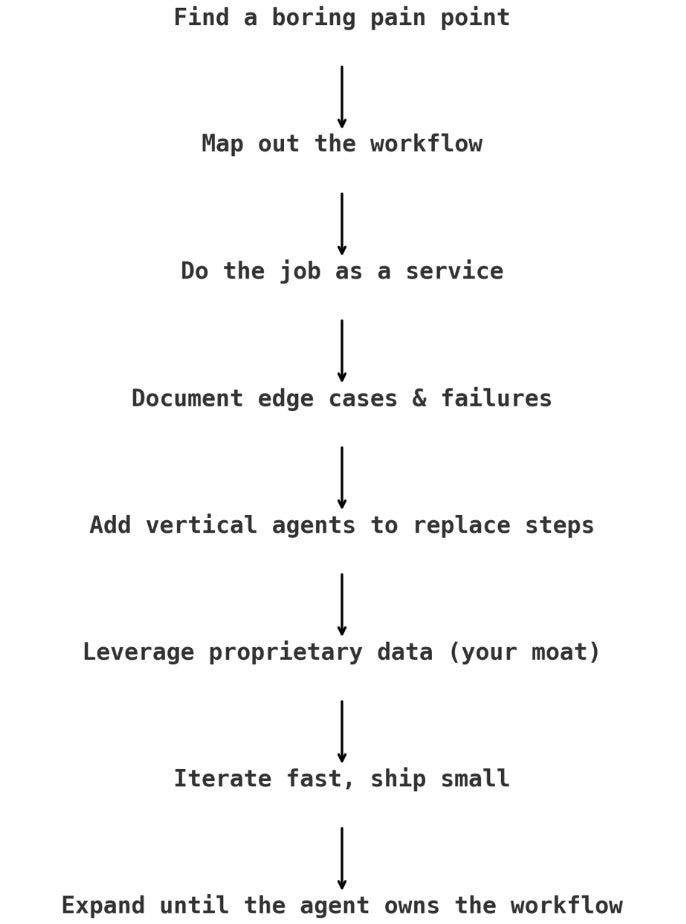
The earlier you start, the more compounding advantage you build—data, distribution, feedback loops, and a better-trained vertical Agent. This category rewards momentum.
What Is the AI Agent in Builder Network?
Our mission is to use AI to replace a large share of the time-consuming, low-leverage work in the venture workflow—sourcing, information gathering, first-pass diligence, and memo drafting, including the hours spent to browse, filter, categorize, and analyze builder data into an initial investment view.
Today, the product is a conversational Associate Agent—an Assistant Agent that understands a fund’s strategy, runs continuous, strategy-aligned diligence on builders, and accelerates deal execution. It’s built for the venture ecosystem broadly: builders, L1/L2 infrastructure teams, angel investors, VC funds, incubators, and accelerators.
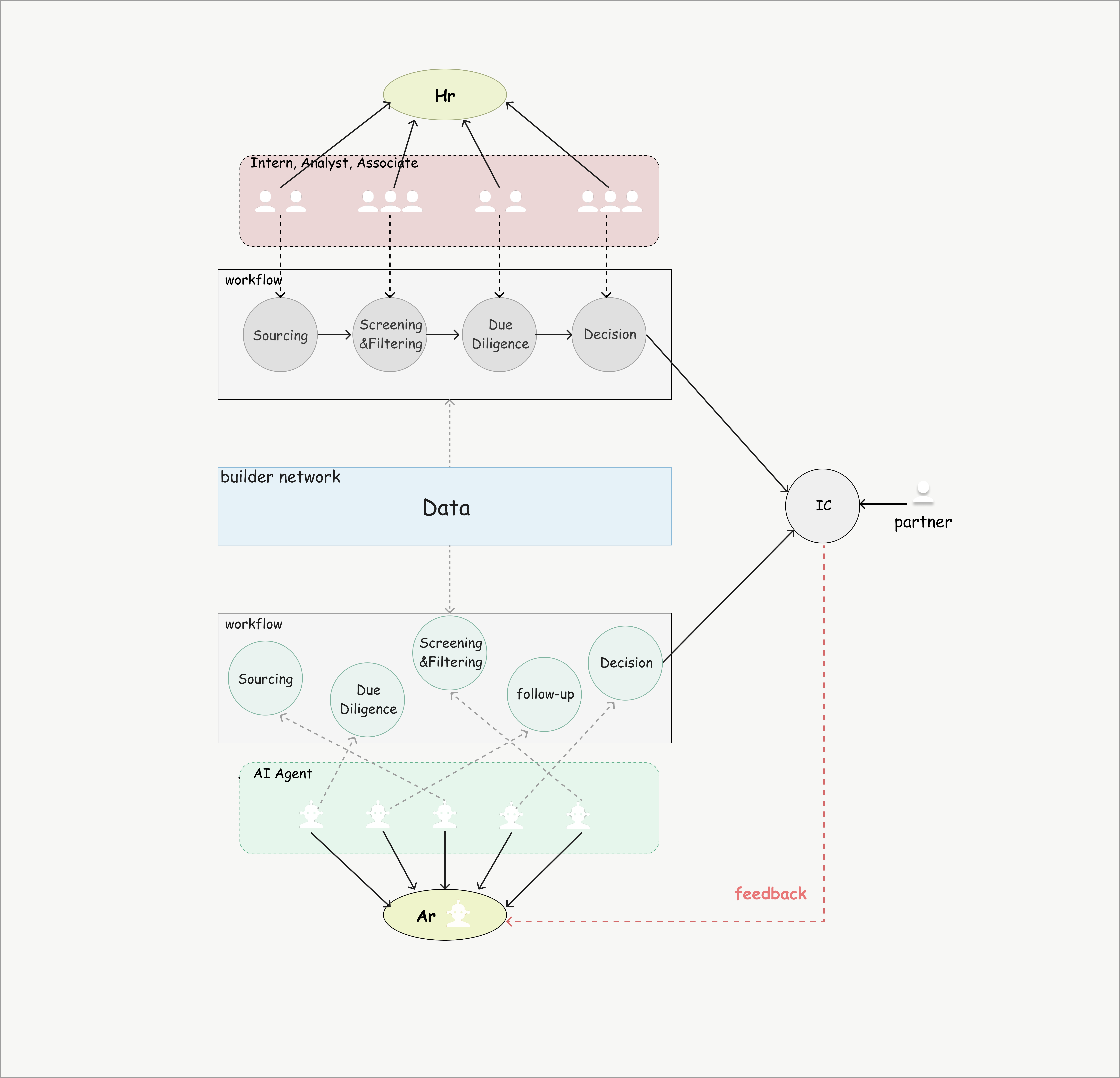
We’re not building a traditional chatbot—and we’re not building traditional SaaS either. We’re building an object-specific, goal-driven Assistant Agent that moves deals forward and produces the analysis, evidence, and memos behind its recommendations. It understands who you are and what you’re trying to achieve, then runs 24/7 to source strategy-matched builders, filter and analyze their signals, and package everything into a decision-ready view—so the human simply makes the call.
Over time, it becomes a personalized Associate: it learns your thinking patterns, investment thesis, and founder preferences. With persistent memory and continuous learning, it compounds—getting increasingly partner-like in how it selects and evaluates builders. I believe Assistant Agents will become the next-generation production and management layer for venture.
We want every player in the global venture ecosystem—L1/L2 infrastructure teams, angel investors, VC funds, incubators, accelerators, and builders—to have an Agent and become a super-individual in the new era. Over the next decade, this will happen. We intend to be one of the earliest teams to make it real.
The Learning Loop Behind the Agent
Building an Agent for venture, I think the hardest part isn’t the model. It’s the loop. Builder sourcing and evaluation aren’t centralized workflows—they’re distributed cognition. The real edge comes from thousands of micro-decisions: which filters you use, who you click into, who you save, who you message, who you follow up with, and who you pass on immediately.
So we’re not treating the Agent as a “chat feature.” We’re treating it as a new interaction layer—one that captures feedback at the exact moment a decision gets made. The key point is straightforward: venture is one of the few domains with unusually strong outcome signals.
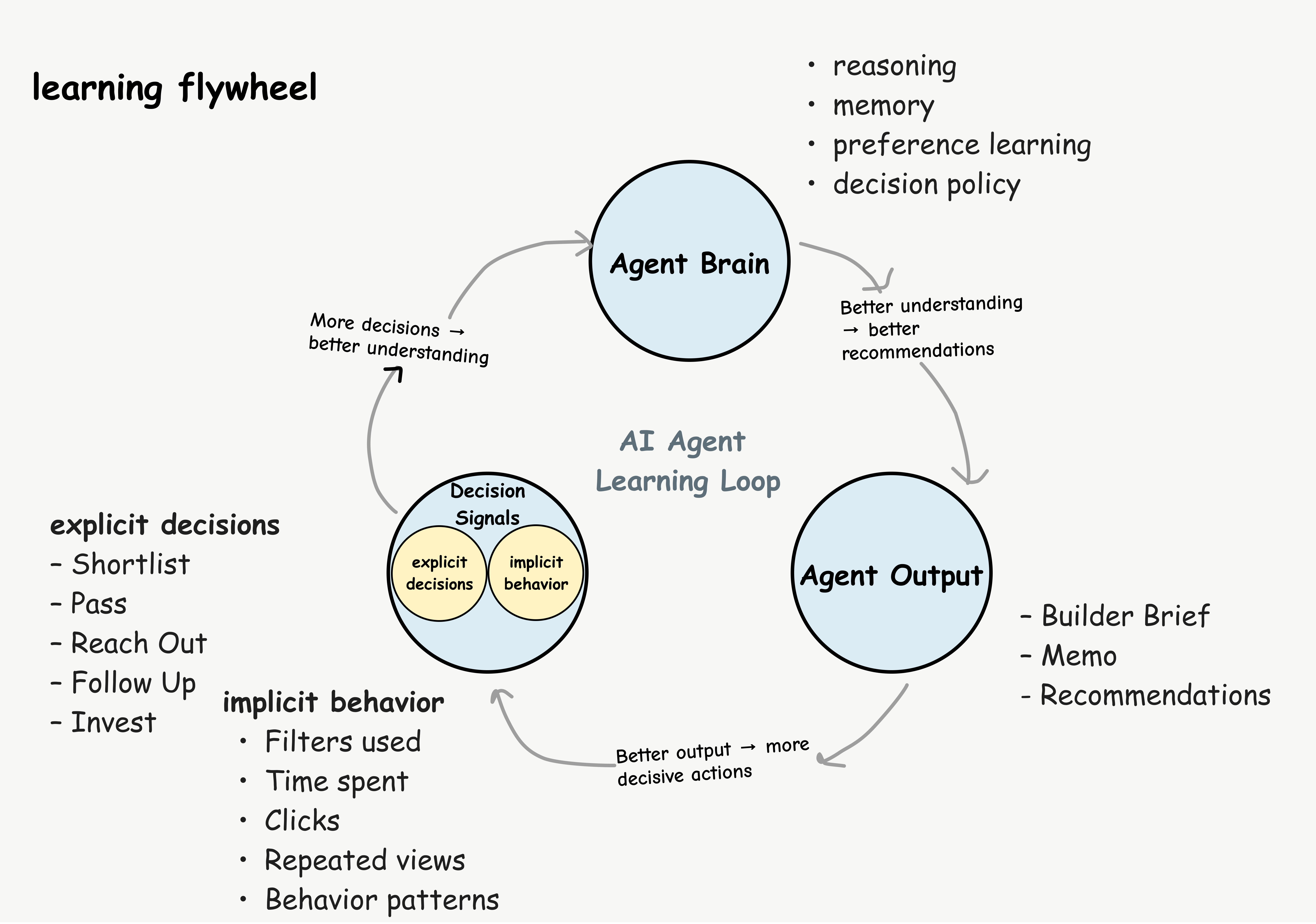
Make an intro or don’t. Follow up or drop. Invest or pass. These aren’t engagement metrics. They’re closed-loop decisions.
The product will learn from two classes of signals: First, explicit decisions. The Agent produces a builder brief and a memo; the user responds with action—shortlist, pass, reach out, follow up. Over time, the system learns your thresholds, your taste, and your firm’s decision style. The Associate Agent gets less generic and more like you. Second, implicit behavior. Which filters you default to. Where you spend time. Which sections of a profile you repeatedly check. What patterns consistently precede a “yes.” The system should learn your operating cadence without adding work to your day.
Given enough cycles, the Agent should move from “general” to “personal.” Not more talkative—more predictive, more opinionated, and more outcome-driven. That also informs the business model. In the near term, we’ll start with subscription plus usage-based pricing. Over time, we expect this to evolve into a pay-per-use model, where Agents are paid directly for the work they perform—searching, analyzing, drafting, and executing—using machine-native payment rails like x402. Long term, pricing should be outcome-aligned, because the point isn’t to sell conversations. The point is to help close deals.
Context Graph: Why Agents Compound Judgment, Not Just Automation
What compounds over time isn’t just model quality—it’s context.
In venture, decisions are rarely rule-based. They’re driven by precedent, exceptions, pattern recognition, and judgment accumulated over years. What matters isn’t just what decision was made, but why it was made in that specific context: what signals were considered, what trade-offs were accepted, and what historical analogies informed the call.
As Agents move into the execution path of venture workflows—sourcing, filtering, diligence, follow-ups—they gain a unique advantage: they can capture decision traces at the moment decisions are made. Every “reach out or pass,” every “follow up or drop,” every “invest or don’t” becomes a durable signal, not just an action.
Over time, these decision traces form what I think of as a Context Graph: a living, queryable record of how judgment is actually applied across builders, markets, and strategies. Not a static database of facts, and not a model’s chain-of-thought—but a compounding map of how decisions happened and why they were allowed to happen.
This is where Builder Network becomes more than a discovery layer. By sitting directly in the venture decision loop, it becomes the natural substrate for this Context Graph to emerge. As the graph grows, the Assistant Agent doesn’t just get faster—it gets more opinionated, more predictive, and more aligned with how each investor and firm actually thinks.
That’s how an Agent moves from generic assistance to genuine judgment support—and why, over time, context becomes the real moat.