

We talk a lot about agents now—agents that research, write, plan, negotiate, and even “execute.” But there’s a quieter question underneath all of this that rarely gets treated as a first-class problem: how do agents actually finish things? Not in theory, not as a demo, but inside real workflows where tasks repeat every day and where someone—human or machine—has to settle value in the moment.
Once an agent moves from advising to acting, payment stops being a checkout experience and becomes part of the execution path. That shift sounds small, but it changes everything about what kinds of markets can exist and who gets to participate in them.
x402 Is Built for Agent Payments
The simplest way I’ve come to frame x402 is this: it’s not designed for people to pay each other. It’s designed for agents to pay automatically, inside the execution path, for small units of work. That matters because the internet already has countless “micro” tasks—data queries, API calls, single-use tools, one-off templates—that are economically awkward under traditional payment rails. When the minimum viable transaction cost is too high, we’re forced into blunt models: subscriptions, bundles, ad-driven attention, or enterprise contracts.
x402 points in the opposite direction: pay-per-use, on demand, task-sized settlement. And that’s why the most important question for x402 isn’t “does the protocol work,” but “where does it become the default behavior”—a place where agents don’t just demo payments, but pay repeatedly because the workflow naturally demands it.
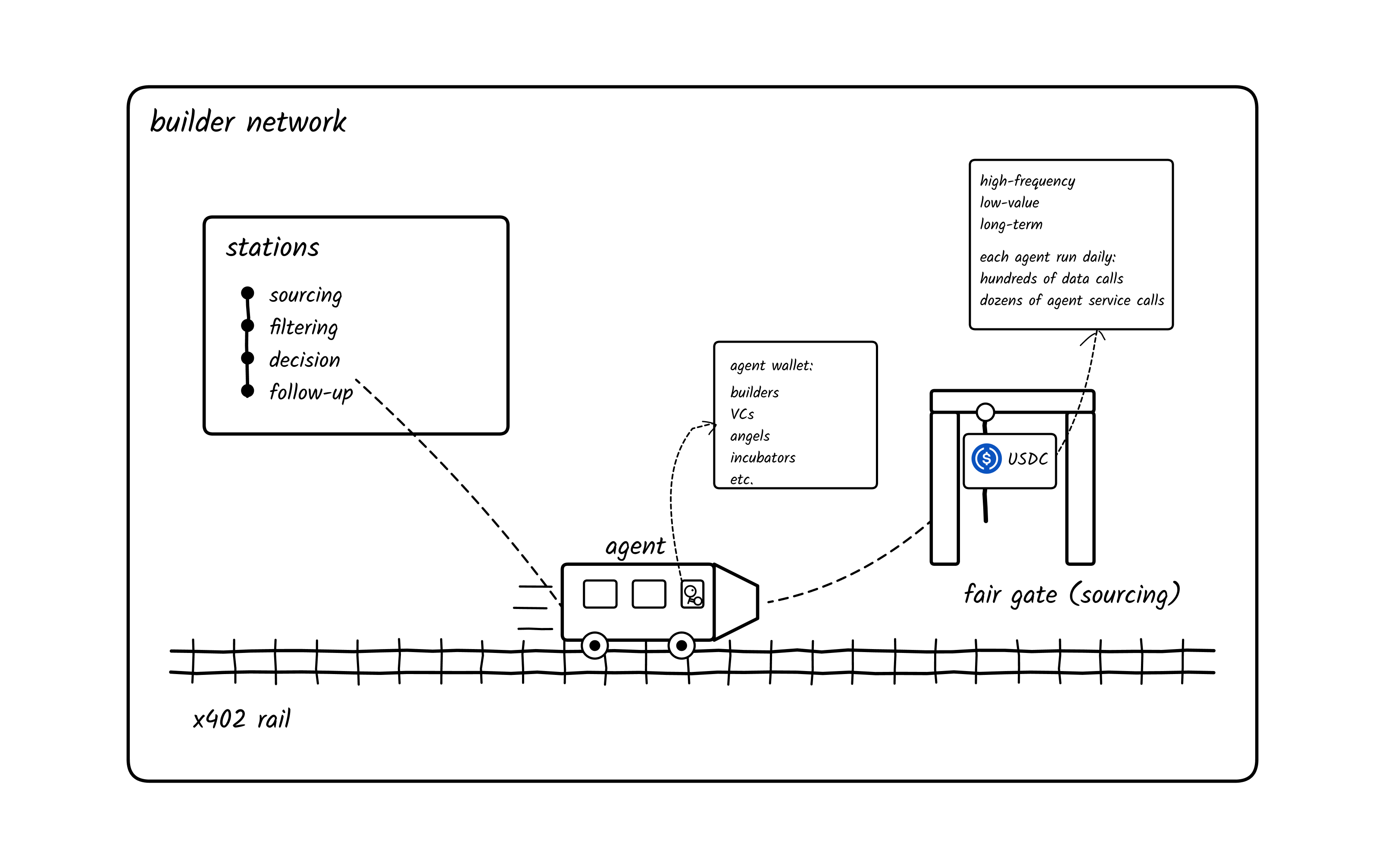
Builder Network is where agent decisions are dense
Builder Network, in my mind, is not a content platform. It’s a work network: long-term, repetitive, and outcome-oriented. Builders keep shipping, updating, iterating, and following up. On the other side, investors, ecosystem operators, and partners do the same: they source, filter, research, maintain relationships, and make a thousand micro-decisions that compound over time.
That’s exactly the kind of environment where agents become more than a chat interface. Agents start to run the workflow. And once agents run the workflow, economic actions appear everywhere—small, frequent, contextual payments that are too granular for humans to manage manually, but perfect for agents to execute programmatically. In that sense, Builder Network is naturally one of the most payment-fragmented, decision-dense environments you can build.
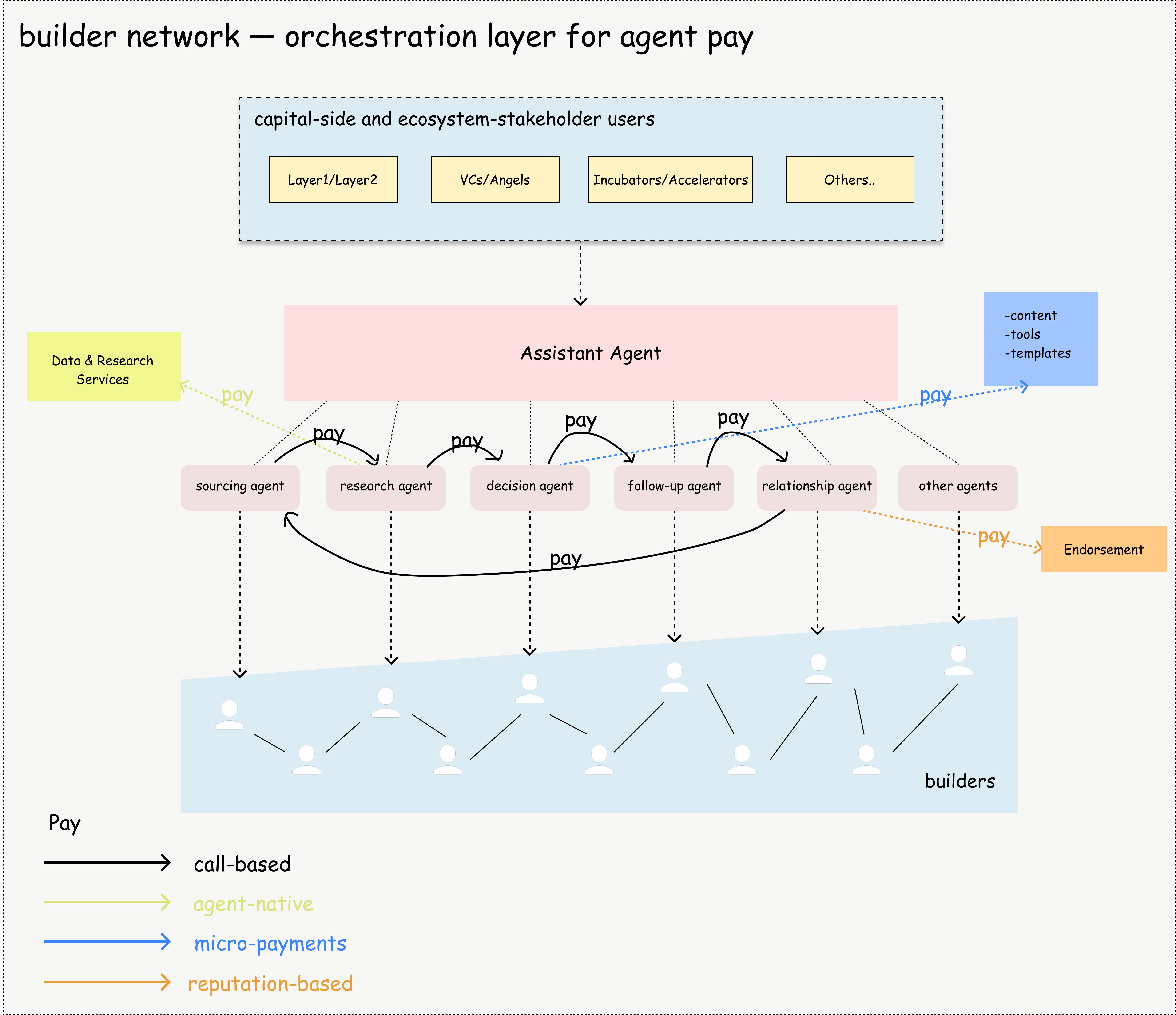
Three payment surfaces inside Builder Network
In Builder Network, I see three primary payment surfaces—simple enough to explain, but powerful enough to shape the whole economy.
First: Agent Pay. This is the functional layer. Agents pay for external data and research, for specialized tools, and for services that sit outside the core product. A sourcing agent might buy a single query. A diligence agent might pay for a dataset snapshot. A “context” agent might pay for an enriched profile. These are not subscription moments; they’re execution moments.
Second: Agent-to-Agent services. As tasks get decomposed, agents don’t just call APIs—they call other agents. One agent specializes in background checks, another in summarization, another in pattern detection. Builder Network becomes the orchestration layer where these micro-services coordinate. And orchestration implies settlement: each agent gets paid for its specific unit of work, not for a seat license or a bundled contract.
Third: micro-payments for content, tools, and templates. Some assets are genuinely valuable but not worth subscribing to—one memo template, one checklist, one niche tool used once. A pay-per-use rail makes these markets real, instead of forcing everything into bundles and subscriptions.
These three surfaces are the “natural” x402 territory inside Builder Network. They create stable, repeated, real-workload transactions—exactly the kind of pattern that looks like a path to product-market fit without needing to evangelize the protocol itself.
Endorsements: when payment becomes judgment
The second major pillar is what I’d call endorsement—real people supporting builders with real money, typically stablecoins. Superficially it resembles “tipping,” but functionally it’s closer to a reputation and credit system. It borrows the visibility of a Product Hunt vote, the immediacy of creator tipping, and the global composability of onchain payments—but it goes further because it’s a costly signal.
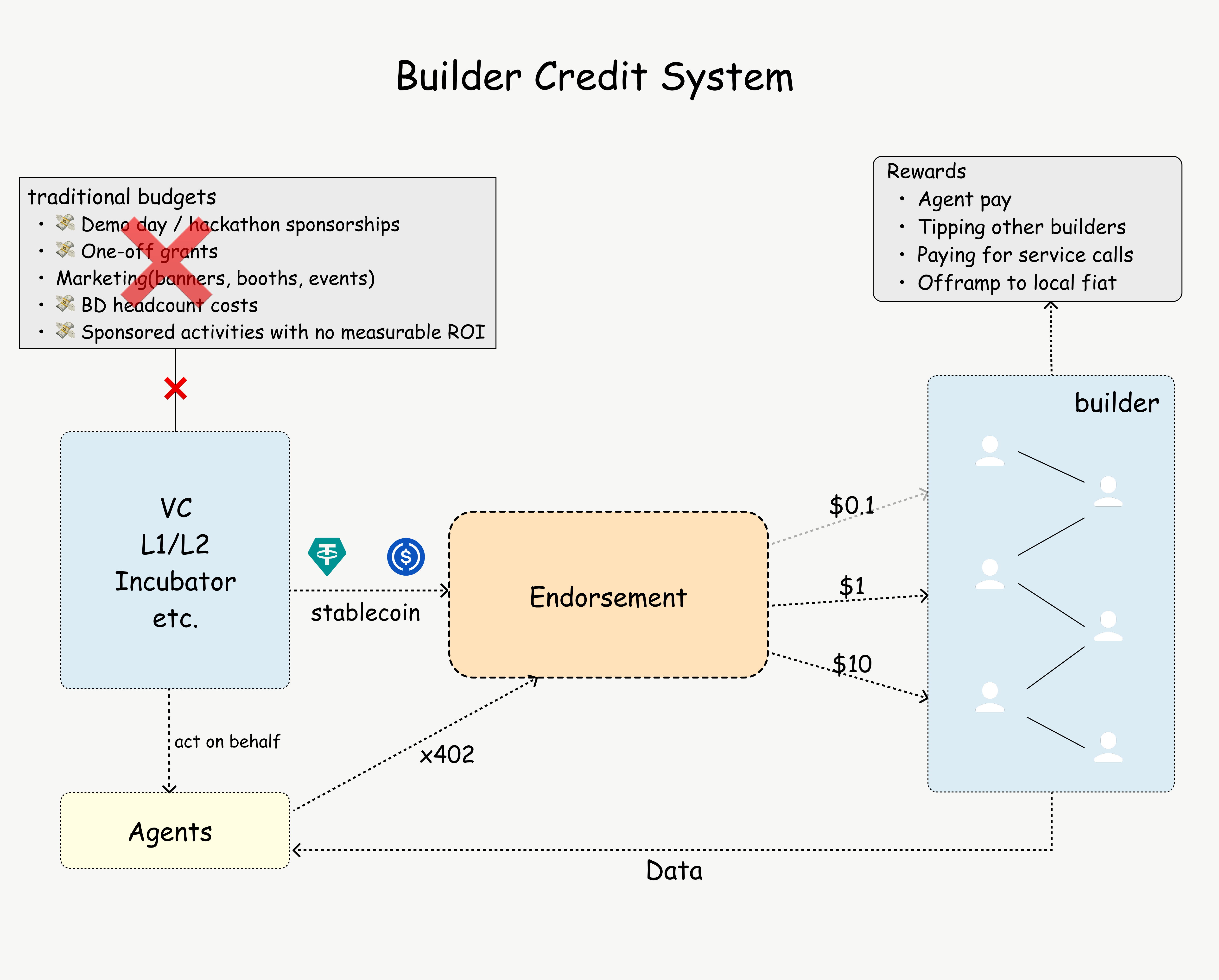
A like costs nothing. A vote costs nothing. A small payment, even $10 or $50, is different: it means someone is willing to bear a loss if they’re wrong. That’s why it’s informative. Over time, endorsement isn’t just “who’s popular,” but who is consistently supported by many independent supporters, across time. It becomes a legible, auditable layer of credibility—especially meaningful for early builders who aren’t ready for institutional checks but still deserve real backing.
This is also where stablecoins matter. If support is meant to be global—anyone supporting any builder anywhere—fiat rails and platform credits quickly become constraints. Stablecoins make the support portable, spendable, and settlement-native for agents as well.
Incentives: turning contributions into a flywheel
Finally, there’s incentives: rewards for the people who help the network stay alive—contributors who fill in profiles, verify updates, and refer builders or users. This isn’t a gimmick; it’s recognizing that network quality has real behavior behind it, and that behavior should be compensated in a way that scales. Whether that reward is stablecoins, crypto, or a platform credit usable for Agent Pay, the intent is the same: keep the system maintained without relying on goodwill alone.
Incentives are a double-edged tool. If they are too extractive or too easy to game, they distort behavior and collapse into farming. The goal is not to maximize activity, but to reinforce actions that measurably improve the network. Long-term, the cleanest version of this is outcome-aligned: payment only occurs when something real happens—when a referral becomes an active contributor, when a data update proves correct, when an agent-delivered result meets a clear success condition.
As the system matures, it becomes important to distinguish between operational incentives and long-term ecosystem support.
While core incentives remain part of the platform’s economic model, complementary structures—such as foundations—can emerge to support broader, cross-platform initiatives, including fellowships, research, and ecosystem-wide grants.
This separation is not about adding governance overhead. It is about durability. Systems that decouple short-term incentives from long-term support structures are more resilient and capable of sustaining broader participation over time.
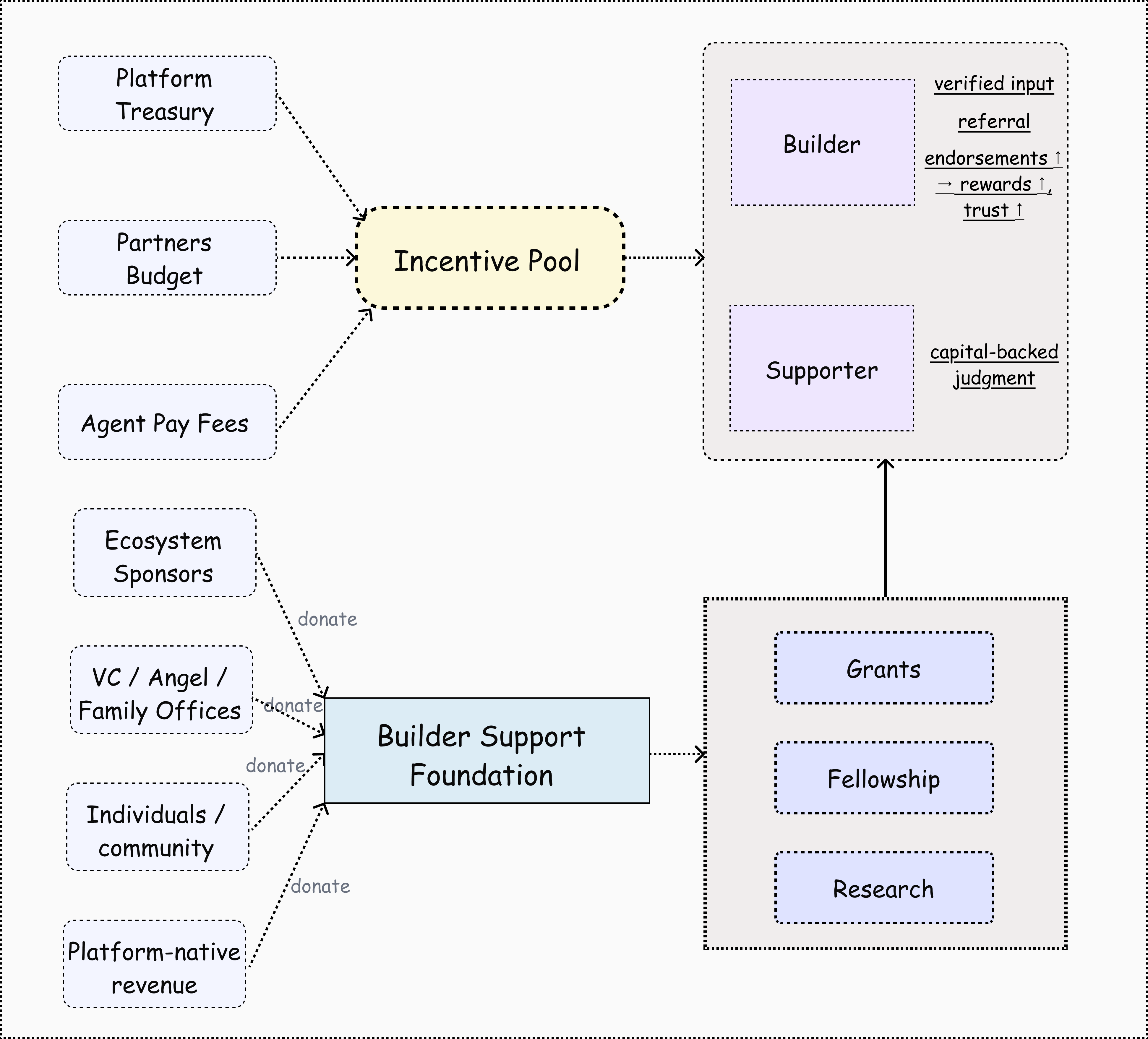
If there’s a bigger takeaway, it’s this: x402 makes task-sized settlement viable, and Builder Network provides a place where that settlement is not optional—it’s simply what execution looks like. When we combine that with stablecoin endorsements and pragmatic incentives, we don’t just add “payments” to a product; we start designing an economy where work, support, and credibility can compound.