

Across Africa, the next phase of development will not be defined only by growth, infrastructure, trade, demographics, or investment. It will also be shaped by a more fundamental question: how effectively can states understand, coordinate, and respond to their own realities?
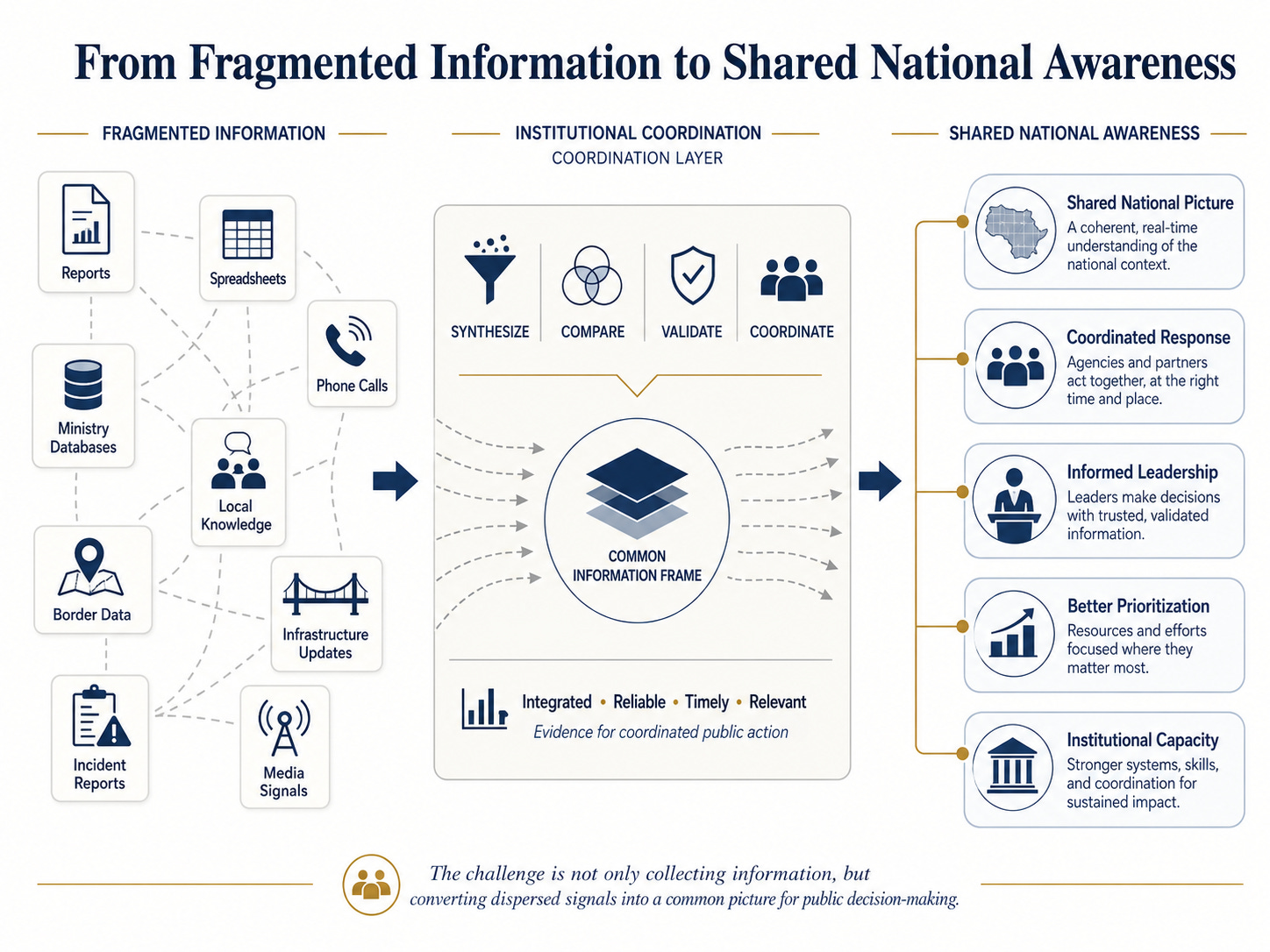
African governments generate and receive large volumes of information every day. Borders, ports, roads, airports, local administrations, security institutions, energy systems, communities, firms, media, and international partners all produce data and operational knowledge. Yet in many contexts, this information remains fragmented across reports, phone calls, spreadsheets, messaging groups, paper records, ministry databases, and institutional silos.
The challenge is therefore not only a lack of information. It is the difficulty of turning dispersed information into shared national awareness.
When national leaders seek to understand where the country is most exposed, which border regions are changing, which infrastructure nodes matter most, which local incidents may become systemic risks, or which institutions need to coordinate, the answers are often slow to assemble.
This is not merely a technical issue.
It is a state capacity issue.
In the digital age, sovereignty is not only about territory, law, international recognition, or borders. It also depends on a state’s ability to understand its territory, coordinate its institutions, protect its people, and act with timely judgment. A state that cannot see itself clearly will struggle to govern effectively.
1. The changing nature of state capacity
Many African states inherited complex political geographies. Borders often reflect historical arrangements rather than natural economic zones, linguistic communities, mobility patterns, trade corridors, ecological systems, or security realities. Preserving inherited borders was essential for sovereignty and continental stability. However, it also created long-term governance challenges.
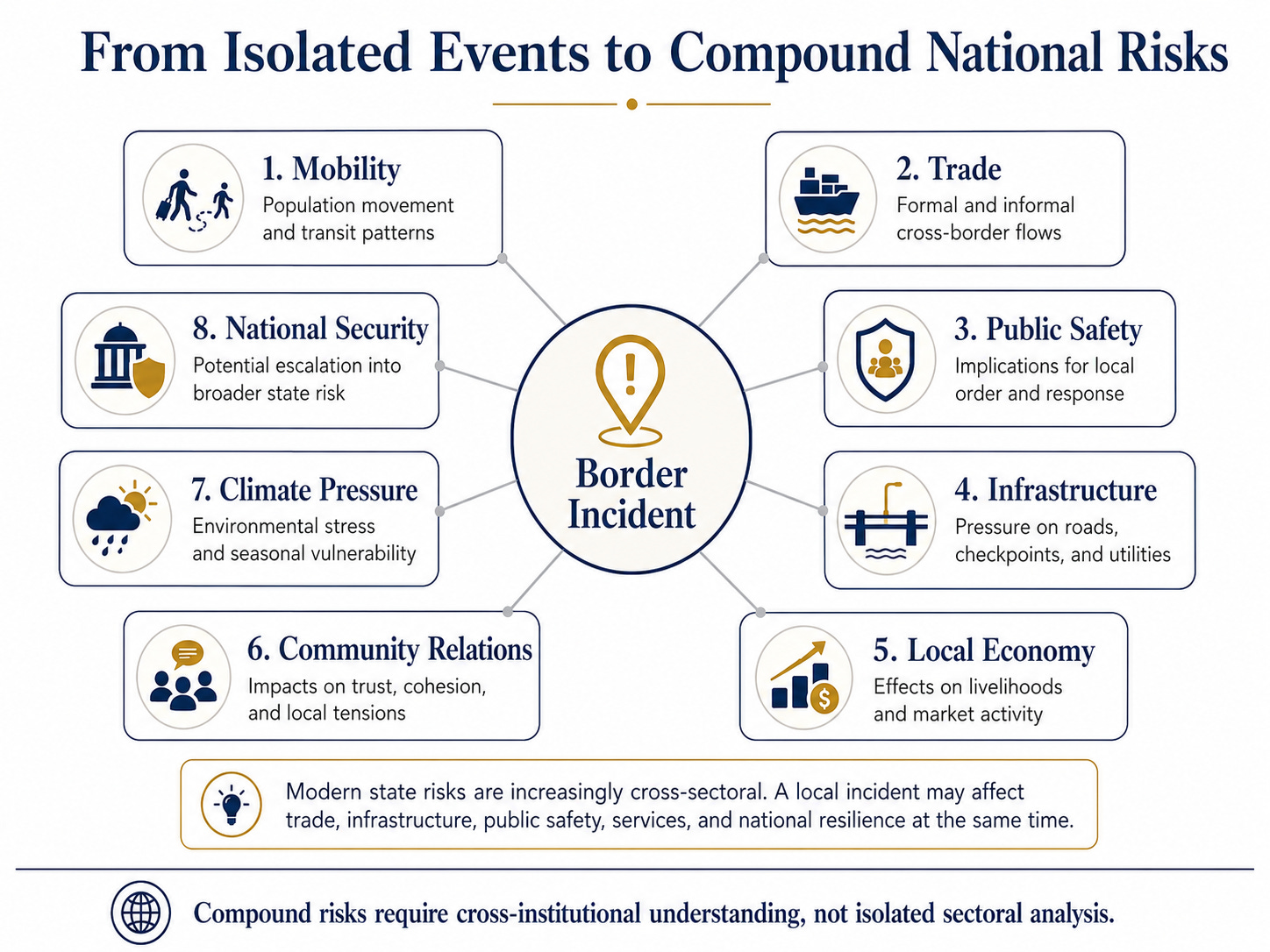
A border region may be, at the same time, a commercial corridor, a family network, a migration route, a pastoral route, an informal trade space, a resource zone, and a security-sensitive area. Border governance therefore cannot be understood only as control. It also requires comprehension.
A government may legally possess a border, but the deeper question is whether it understands what happens along that border: who moves through it, what goods pass through it, which communities depend on it, which routes are formal or informal, and which pressures are economic, social, environmental, or security-related.
The same logic applies beyond borders. Local incidents, infrastructure disruptions, resource pressures, climate events, public safety risks, and cross-border dynamics increasingly interact. Modern state capacity requires the ability to understand these relationships, not only record isolated events.
2. From isolated risks to compound national risks
Many policy discussions still treat development, security, infrastructure, trade, and governance as separate domains. In practice, they are increasingly interconnected.
A road disruption may affect food supply, emergency response, commercial logistics, public service delivery, and local stability. A port or airport incident may affect trade flows, energy supply, public security, and national revenue. A local dispute may have economic, environmental, social, and political dimensions. A border event may involve trade, mobility, organized crime, community relations, and national security at the same time.
These are compound risks. They cannot be managed effectively if institutions only see their own part of the problem.
The central challenge is not only early warning. It is the ability to move from warning to shared understanding, and from shared understanding to coordinated response.
This requires more than reports. It requires a common picture of national reality.
3. The need for a common picture of reality
In many government systems, different institutions hold different versions of national reality.
Local authorities understand local conditions. Security institutions understand security pressures. Transport agencies understand roads. Energy agencies understand power systems. Interior ministries understand administrative realities. National leadership receives briefs, summaries, and reports.
Each perspective may be valid. But without a common picture, coordination depends heavily on personal relationships, ad hoc communication, and institutional memory. That may work for limited problems, but it does not scale into modern governance.
A common picture does not mean centralizing all authority or replacing institutional mandates. It means allowing institutions to begin from the same understanding when urgent decisions must be made.
A country cannot coordinate what it cannot see. It cannot prioritize what it cannot compare. It cannot respond quickly if every department is operating from a different version of reality.
This is why state capacity in the digital age depends not only on data collection, but on the organization of data into shared awareness.
4. Visibility as a governance capability
Visibility is often misunderstood as a technical or design issue. In public governance, it is better understood as a cognitive and institutional capability.
Text explains. Tables record. Meetings deliberate. But governance also requires the ability to understand relationships: between territory and population, infrastructure and economic activity, borders and mobility, local incidents and national risks, institutional mandates and response capacity.
A state exists in space. Borders, roads, cities, ports, airports, rivers, power systems, administrative regions, communities, and security pressures all have spatial relationships. When these relationships remain hidden in disconnected documents, decision-makers see fragments. When they become visible, the state begins to see structure.
This visibility is not intended to militarize governance or expand control over society. It is intended to strengthen awareness, coordination, accountability, and response capacity.
The more clearly a state understands its own reality, the better it can allocate limited resources, maintain institutional stability, and exercise strategic judgment in complex environments.
5. Digital sovereignty and responsible partnership
Digital sovereignty is sometimes framed as a choice between foreign dependence and complete self-reliance. This is a false binary.
No modern state develops in isolation. Technology, finance, infrastructure, expertise, and institutional knowledge move across borders. African countries will continue to work with partners from North America, Europe, China, the Middle East, India, and other regions.
The question is not whether African states should cooperate. The question is what kind of cooperation strengthens long-term national capacity.
A state can use external technology without surrendering control over its data. It can work with global companies without accepting opaque dependency. It can adopt advanced expertise while building local teams. It can welcome international partners while preserving governance rights, choice, and long-term autonomy.
Digital sovereignty is not isolation. It is the ability to choose, understand, govern, adapt, and sustain critical capabilities.
The most constructive partnerships are those that leave the state stronger, more capable, and less dependent on any single external path over time.
6. Alignment with Africa’s long-term development agenda
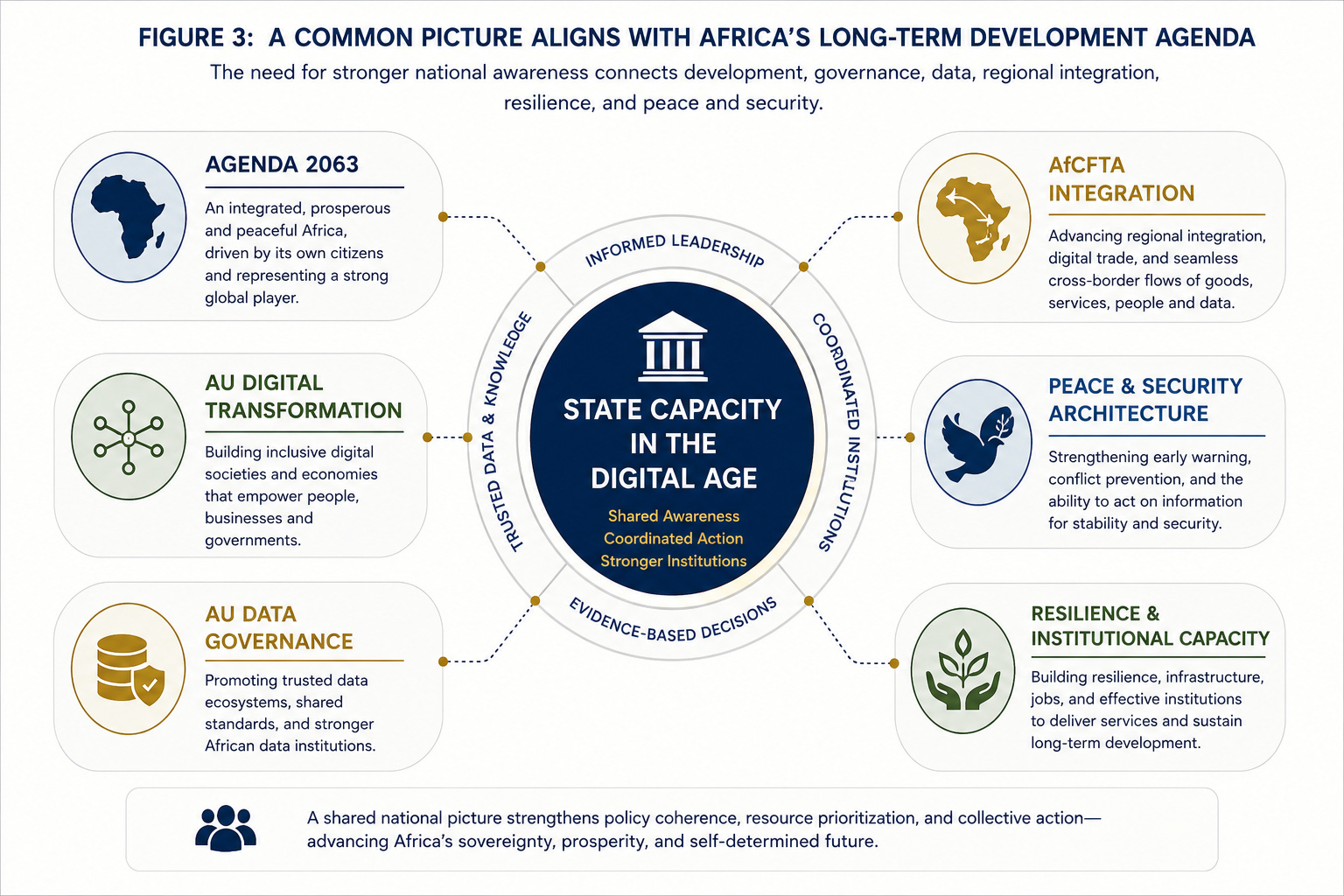
The need for stronger national cognition is consistent with Africa’s broader policy direction.
Agenda 2063 emphasizes a more integrated, peaceful, prosperous, well-governed, and self-determined Africa. The African Union’s digital transformation agenda highlights inclusive digital societies and economies. The AU data policy conversation stresses data governance, shared standards, trusted data flows, and stronger African data institutions. The African Continental Free Trade Area points toward regional integration, digital trade, interoperability, and cross-border coordination. Africa’s peace and security architecture emphasizes early warning, conflict prevention, and the ability to translate information into timely response. Development institutions continue to highlight the importance of resilience, institutional capacity, infrastructure, jobs, and regional integration.
These agendas may appear separate. But they share one underlying theme: African states need stronger capabilities for converting fragmented information into coordinated public action.
This is the missing layer between information and action.
7. Regional integration requires operational visibility
Regional integration is not only legal or diplomatic. It is operational.
Trade agreements, infrastructure corridors, digital trade protocols, and cross-border cooperation all depend on the ability of states to understand what happens across borders, logistics networks, administrative systems, and infrastructure nodes.
Borders are not only points of control. They are points of connection.
For Africa, this is especially important. The future of regional integration depends not only on moving goods, people, capital, and data across borders, but on doing so in ways that are trusted, secure, efficient, and governable.
This requires better visibility into border dynamics, infrastructure dependencies, institutional responsibilities, and emerging risks.
If regional integration is a strategic goal, then border awareness, infrastructure visibility, and inter-agency coordination are not peripheral issues. They are part of the operating layer of integration.
8. From fragmented reality to governable reality
State-building is, in many ways, the process of turning dispersed reality into governable reality.
Tax systems convert dispersed economic activity into fiscal capacity. Identity systems convert dispersed populations into service delivery capacity. Road networks convert dispersed regions into national markets. Power systems convert energy resources into productive capacity. Communications networks connect communities into a shared information space.
In the same way, modern states need to convert dispersed risks, events, infrastructure dependencies, and institutional knowledge into national awareness.
Without this connective layer, governments rely too heavily on individuals to connect information manually. As states become more complex, individual memory, personal networks, meetings, and static reports are not enough.
Institutions need information. Information needs organization. Organization needs governance. Governance needs sovereignty.
Conclusion: sovereignty needs a common picture
The question is not whether African states will digitize. They already are.
The real question is what kind of digitization will define the next phase.
Will digital capabilities remain fragmented across departments, donors, vendors, projects, and ministries? Or will they gradually form a coherent layer of national capability?
Will digitalization stop at payments, identity, tax, customs, and consumer technology? Or will it extend into resilience, crisis response, border coordination, public safety, infrastructure protection, and strategic decision-making?
Africa does not only need more data. It needs better ways to convert data into state awareness. It does not only need early warning. It needs the institutional capacity to move from warning to response. It does not only need international partnership. It needs partnerships that strengthen sovereignty, capability, and long-term choice.
In the twentieth century, sovereignty was often represented by flags, borders, armies, and diplomatic recognition.
In the twenty-first century, sovereignty also requires something quieter but equally important: the ability of a state to understand itself.
A state that cannot see itself clearly cannot fully govern itself.
In the digital age, sovereignty needs a common picture.