

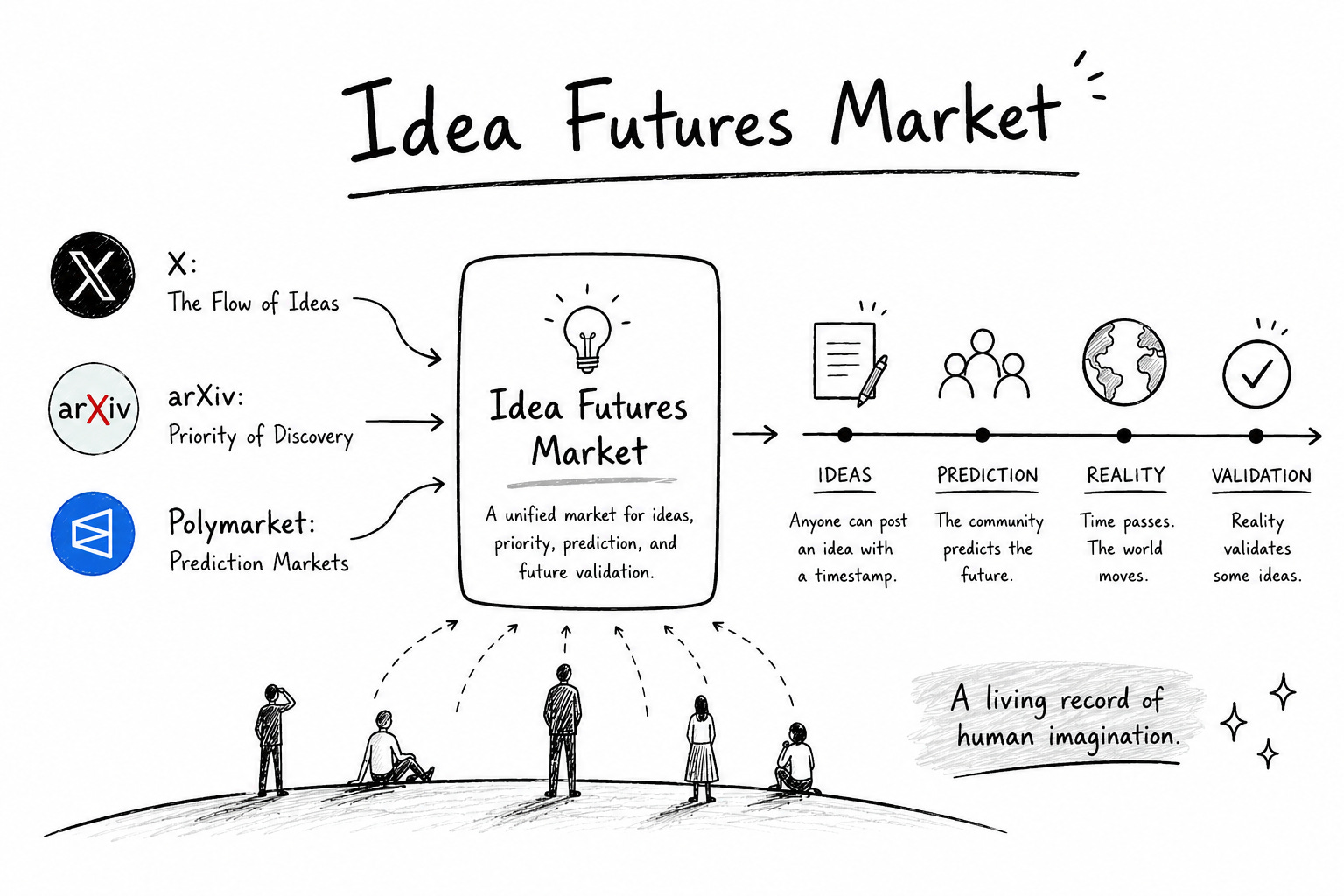
The Value of Ideas That Never Get Built
I’ve always been a curious person.
My mind constantly wanders into questions about how the future might look: new products, new technologies, new systems, new ways society could evolve.
Over the past year, I’ve written essays and explored countless product ideas. Many of them were about startups and future technologies.
But I gradually noticed something:
I have far more ideas than I have time.
There are many ideas I believe are interesting, sometimes even promising, but realistically I cannot build all of them. Starting a company requires focus, time, and commitment. Even the most productive founders can only pursue a few projects in their lifetime.
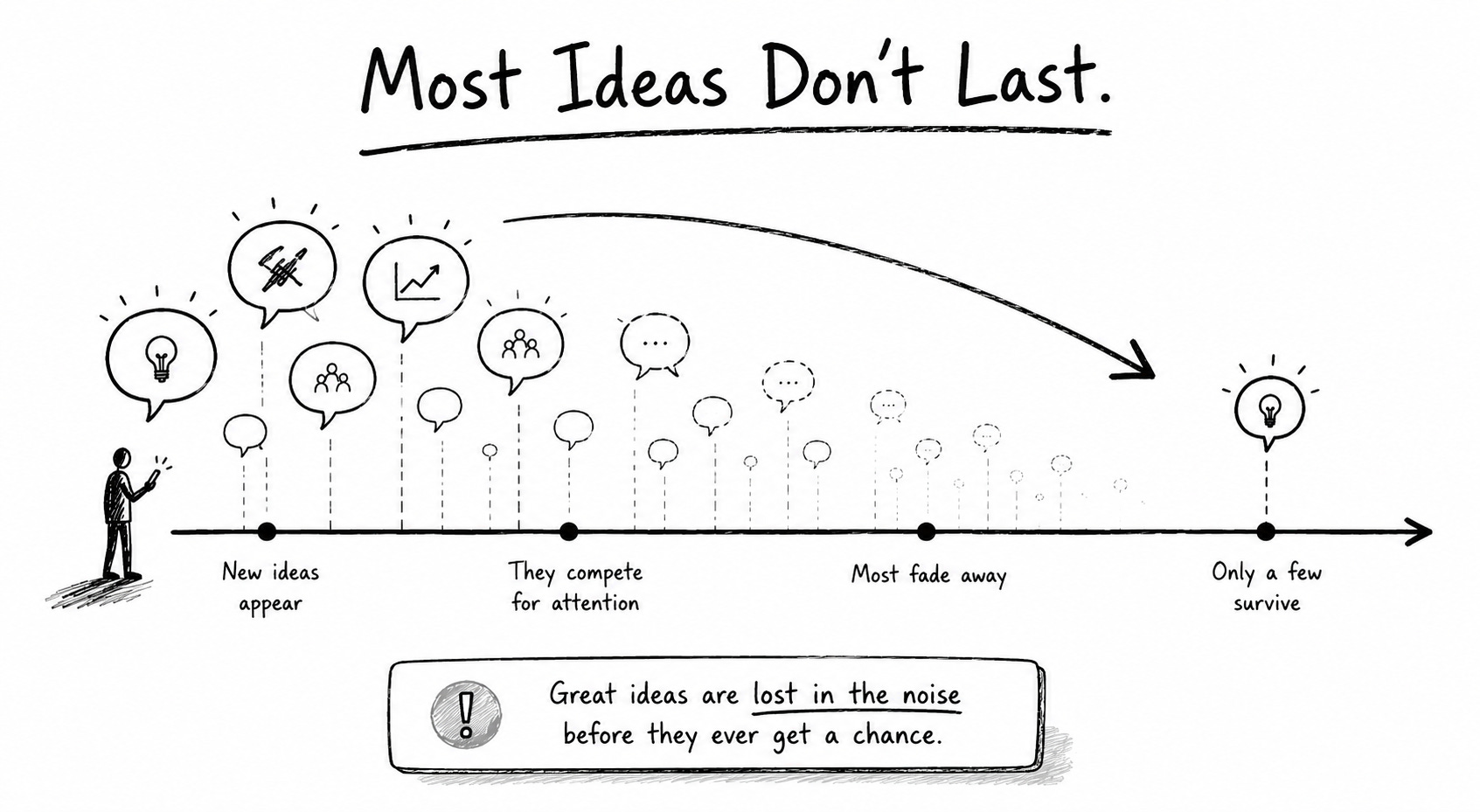
So what happens to the rest of the ideas?
Most of them simply disappear.
They remain scattered across notes, private documents, or half-written drafts. Over time, they lose visibility and eventually vanish.
This feels like a loss.
Not because every idea deserves to become a company, but because ideas themselves have value.
Some ideas inspire others.
Some ideas shape how people think.
Some ideas predict what the world will eventually build.
And sometimes, years later, someone launches a product that looks remarkably similar to an idea that existed long before.
But by then, no one remembers who first thought of it.
This made me think about a different possibility:
What if ideas themselves could be recorded, timestamped, discussed, and evaluated over time?
What if there was a public system where ideas about the future could exist as assets of thought?
That question led to the concept of Idea Futures Market.
An Idea Futures Market is essentially:
A public market for ideas about the future.
Or more precisely:
A platform where ideas about the future are recorded, predicted, and verified over time.
The goal is simple:
Record ideas
Timestamp them
Let people evaluate them
And eventually see which ideas become reality
X for Ideas. arXiv for Priority. Polymarket for Prediction.
At first glance, you might think:
Don’t we already have platforms for this?
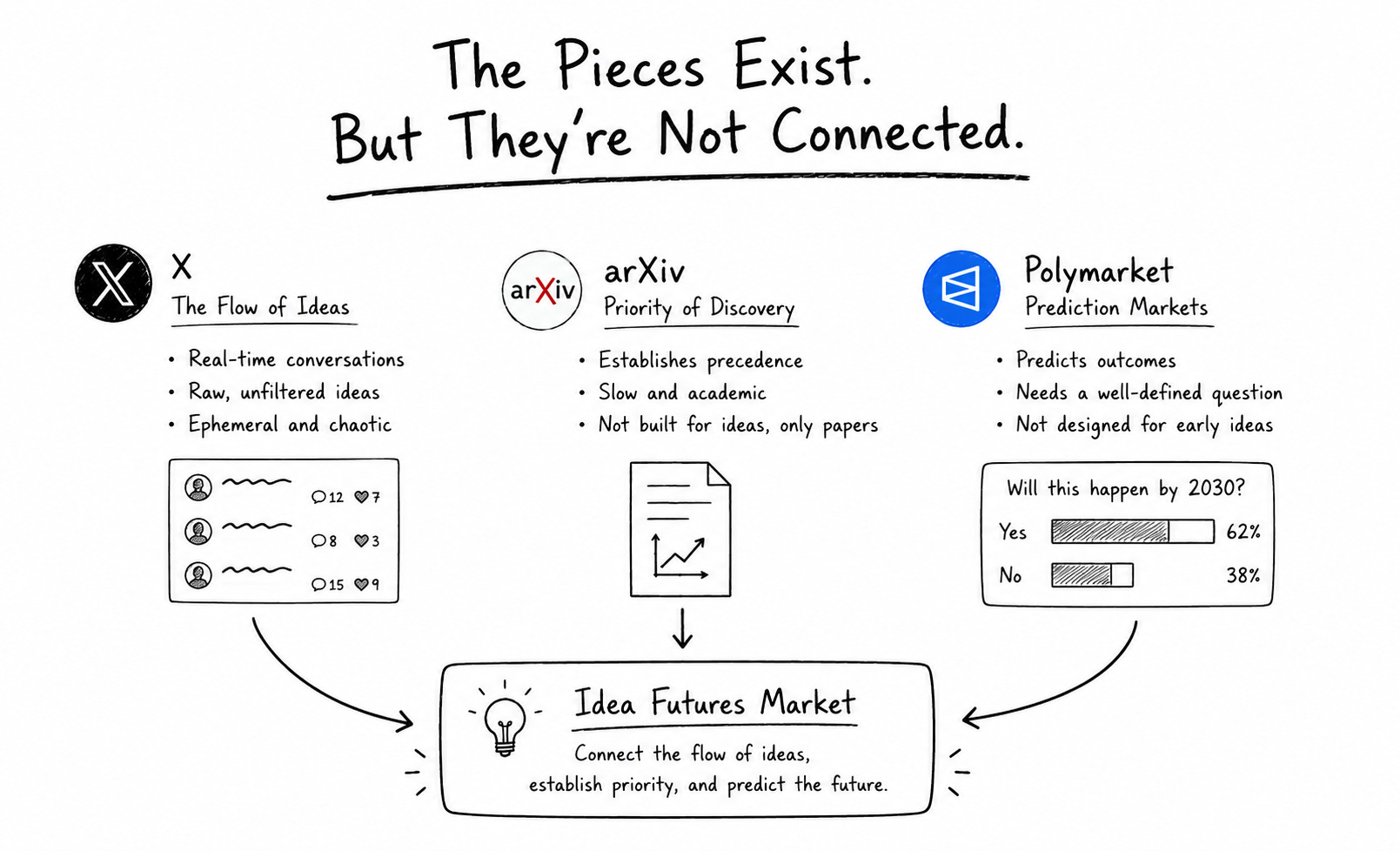
In some ways, yes. But each existing system only solves part of the problem.
Idea Futures Market sits somewhere between three familiar models:
X for ideas
arXiv for priority
Polymarket for prediction
But none of them fully capture what an idea market could be.
X: The Flow of Ideas
On platforms like X, people constantly share ideas, predictions, and observations about the future.
But the timeline format makes ideas fragile. They quickly disappear in the feed, mixed with news, memes, and unrelated content.
Ideas on social media are visible but not persistent.
There is no structured system for recording them over time.
arXiv: Priority of Discovery
In academia, the concept of priority is extremely important.
Researchers publish papers on arXiv partly to establish who discovered something first.
This acts as a timestamped record of intellectual priority.
But arXiv is designed for finished research, not speculative ideas about products, startups, or technological possibilities.
Polymarket: Prediction Markets
Prediction markets like Polymarket allow people to bet on future events.
But they require clear, objectively resolvable outcomes.
Many ideas about the future don’t work that way.
Questions like:
Will this type of product exist someday?
Will this idea eventually become a startup?
These timelines can span years or decades.
They are difficult to resolve in a traditional market.
Idea Futures Market takes a different approach. It doesn’t require strict financial settlement. Instead, it focuses on idea discovery, prediction, and validation over time.
Core Mechanism — The Idea Asset System
At the center of Idea Futures Market is a concept called the Idea Asset System.
The system revolves around three core processes.
1. Proof of Idea
The first function is simple but powerful.
Every idea receives a timestamped record.
This establishes the time priority of the idea.
Each idea includes:
Idea ID
Creator
Timestamp
Together, these elements form what we call:
Proof of Idea.
This does not mean ownership of the idea.
But it proves that the idea existed at a specific moment in time.
2. Idea Discovery & Prediction
Once ideas are published, the community can engage with them.
People can evaluate questions like:
Is this idea plausible?
Could someone build this in the future?
Does this idea predict a real product category?
Instead of financial betting, the system tracks prediction signals.
These could include:
votes
predictions
discussions
community confidence
Over time, users build a track record of how accurately they evaluate ideas.
3. Future Validation
The most interesting part happens later.
Sometimes an idea posted years earlier eventually appears in reality.
A startup launches.
A product category emerges.
A new technology becomes viable.
When that happens, users can submit Link to Reality.
They provide evidence:
Startup name
Product
Documentation or link
The community then evaluates:
Is this the same idea?
If the community agrees, the idea becomes validated.
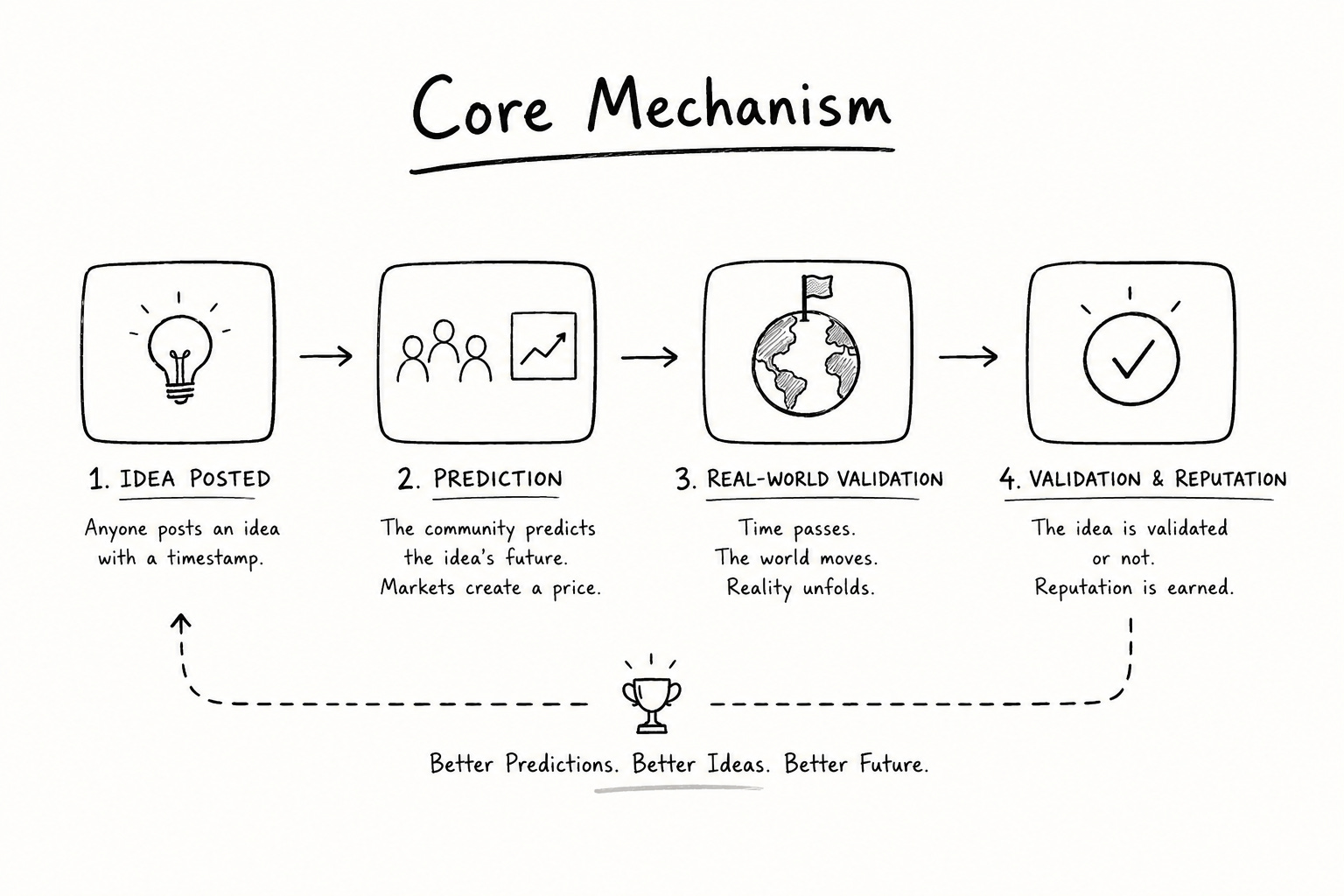
The timeline is complete:
Idea → Prediction → Reality.
Product Design
The core product consists of four main components.
1. Idea Posting
Users can publish ideas directly on the platform.
Each idea automatically generates:
Idea ID
Timestamp
Creator
Together, these elements create the Proof of Idea record.
Ideas can range from:
startup concepts
product designs
technological possibilities
social systems
future predictions
The platform becomes a structured feed of future possibilities.
2. Idea Prediction
The community can evaluate each idea.
For example, a question might appear alongside an idea:
Will this idea exist in 5 years?
Users participate by:
voting
predicting
discussing
Over time, the platform tracks prediction accuracy.
Some users will consistently recognize ideas that later become real.
Others will not.
This gradually builds a prediction reputation layer.
3. Idea Validation
When the real world catches up with an idea, validation begins.
A user submits a Link to Reality, including:
Startup
Product
Evidence
The community evaluates whether the real product matches the original idea.
If consensus is reached, the system marks:
Idea Validated.
This creates a visible connection between the idea and the reality it predicted.
4. Idea Reputation
Unlike financial markets, the core incentive of the platform is reputation.
Users gain reputation by:
posting ideas that later become real
correctly predicting which ideas will succeed
identifying real-world validations
Over time, this creates a new type of reputation signal:
Who consistently understands the future.
Who Would Use an Idea Futures Market?
If a market for ideas existed, who would actually use it?
The most natural users are people who constantly think about the future.
Builders and Founders
Founders and product builders generate far more ideas than they can realistically build.
Most of those ideas disappear.
An Idea Futures Market gives them a place to:
record ideas
establish priority
see how others evaluate them
Instead of losing ideas, builders can leave a public trail of thought.
Technologists and Researchers
People working in emerging technologies often see possibilities long before they become obvious.
Many of these insights remain informal — shared in conversations, tweets, or private notes.
A structured idea market allows these observations to be recorded and revisited years later.
Investors and Analysts
Investors spend their careers evaluating ideas about the future.
A platform that tracks idea prediction and validation could create a new signal:
who consistently understands the future early.
Over time, prediction accuracy becomes a form of intellectual reputation.
Why Would People Use It?
Users do not come to this platform mainly to make money.
People use this platform for different reasons:
to record ideas
to prove priority
to predict the future
to build intellectual reputation
The core psychological reward is simple:
I saw this coming.
Some people enjoy being right about the future.
This platform simply gives that instinct a structure.
How Might It Evolve?
In its earliest form, Idea Futures Market may look like a simple idea archive.
Over time, it could evolve into something more interesting.
A system where:
ideas accumulate
predictions are tracked
reality eventually validates some of them
What emerges is something like a living record of human imagination.
A place where ideas move through a visible lifecycle:
Idea → Prediction → Reality.
Over a long enough timeline, this becomes more than a product. It becomes a public archive of how people imagined the future.
Conclusion
Ideas are strange things.
Most of them never become reality.
Some of them quietly shape the future.
Right now, we lack a system that records and evaluates ideas over time.
We have social media for discussion.
Academic archives for research.
Prediction markets for specific events.
But we don’t yet have a market for ideas themselves.
An Idea Futures Market attempts to create that space.
A place where ideas can exist publicly.
Where they can be discussed, predicted, and eventually compared with reality.
Not to determine who owns the future.
But to see who understood it first.
Ideas are easy to generate; it is the abilities to turn them into reality that are hard to master.