

About ten days ago, I saw the news that Jack Dorsey’s company Block, Inc. (formerly Square) was laying off a large number of employees. That news immediately triggered a question in my mind: why would such a large and seemingly healthy company make such a drastic cut, and why now?
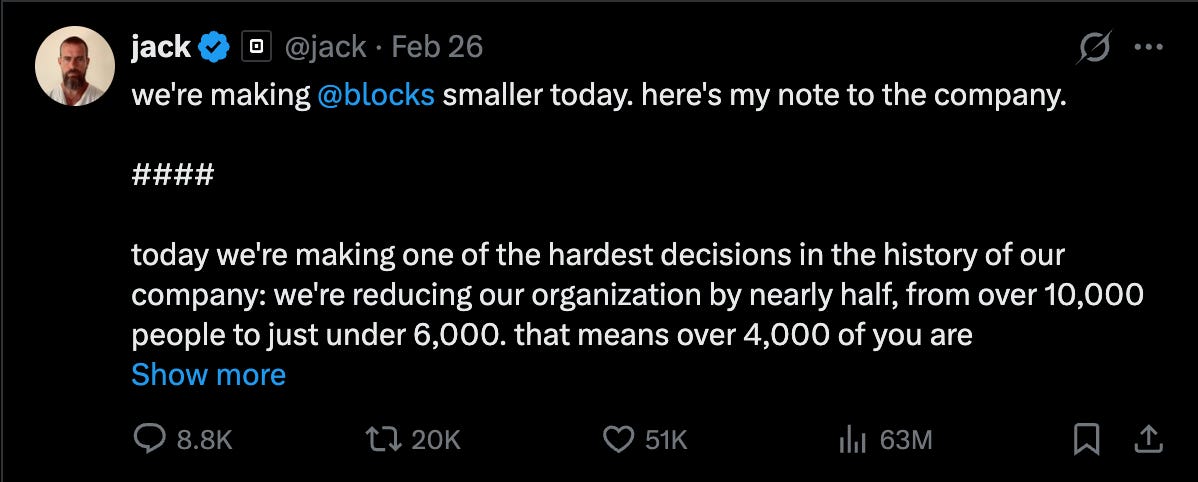
Behind many layoffs today is the same structural shift. AI is quietly changing how production works. As AI systems continue to improve, they are increasingly capable of performing tasks that once required human labor. Activities that previously needed entire teams can now be executed by AI.
This raises a deeper question about the future of human value. If AI can increasingly handle execution, what remains uniquely human? What becomes more valuable, rather than less, in the age of AI?
The answer may lie in something simple but fundamental: ideas.
As Albert Einstein once wrote, “The formulation of the problem is often more essential than its solution.” In the age of AI, this observation becomes even more relevant. AI can assist humans in solving problems, generating content, writing code, designing products, and automating workflows. But deciding what problems are worth solving remains a distinctly human capability.
Ideas therefore become more valuable. But more precisely, what becomes scarce is not just ideas themselves, but the combination of ideas, taste, and judgment—the ability to identify what is worth building in the first place.
This shift also changes what it means to build a company. In the past, transforming an idea into a real project required significant time, coordination, and resources. Today, AI dramatically increases individual productivity. A single builder can now prototype products, design interfaces, write code, and launch websites at a speed that would have been unimaginable only a few years ago.
Which naturally leads to a new question:
Could AI dramatically shorten the time it takes for an idea to become an executable project?
This question eventually led to the concept behind this product: a system designed to help founders turn raw ideas into structured, evaluable, and launchable ventures within minutes.
As one-person startups become increasingly common, tools like this could help a new generation of builders move faster and make better decisions.
The Problem: The Gap Between Idea and Venture
Despite the growing availability of tools, the earliest stage of entrepreneurship still contains enormous uncertainty.
Every year, thousands of startups fail. Many of these failures begin with the same pattern: someone has an idea, becomes excited about it, and immediately starts building. The idea itself is rarely evaluated in a structured way before significant time, energy, and capital are committed.
Without structured feedback, early ideas often remain vague. Market assumptions may be incorrect, the competitive landscape poorly understood, and the path to execution unclear. Founders may not know where the real risks lie, how investors typically evaluate new ventures, or whether their idea actually has the potential to become a viable company.
Another friction appears during the transition from idea to project presence. Even at the earliest stage, most startups need a basic external structure: a clear narrative explaining the project, a landing page, a domain name, some form of branding, and initial social media messaging. These elements are not necessarily complex, but they are often expected for a project to appear credible.
For early-stage founders, preparing these materials can become surprisingly distracting. Designing a landing page, thinking about branding, writing descriptions, choosing a domain name, and preparing launch messaging can easily fragment time and attention. Hiring professionals introduces cost and coordination overhead, while doing everything manually slows down experimentation.
As a result, many founders spend weeks preparing materials before they can even test whether an idea resonates. In fast-moving markets, this delay can mean missing opportunities entirely.
The real problem is the lack of a fast, structured way to turn an idea into something that can be judged, presented, and tested in the real world.
Prediction: The Age of the One-Person Startup
The rise of AI does not just change how companies are built. It changes who can build them. Over the next five years, several structural shifts are likely to happen at the same time.
First, the cost of starting a company will approach zero. AI tools are rapidly compressing the cost of design, coding, research, marketing, and operations. Tasks that once required specialized teams can increasingly be performed by individuals working with AI systems.
Second, one-person companies will become increasingly common. A single founder will be able to operate what previously required a small team, using AI as a force multiplier across nearly every function of a business.
Third, AI will increasingly function as a form of co-founder infrastructure—assisting with decision-making, experimentation, and execution throughout the lifecycle of building a company.
In such an environment, the scarcity shifts away from labor and tools. What becomes valuable instead are the human capabilities that AI cannot easily replicate: good ideas, judgment, taste, and the ability to identify worthwhile opportunities.
The bottleneck of entrepreneurship therefore moves from execution to decision quality.
Which leads directly to the question: How can founders evaluate ideas faster and better?
That question is the foundation of this product.
Product Design: The Venture Trial and Launch Kit
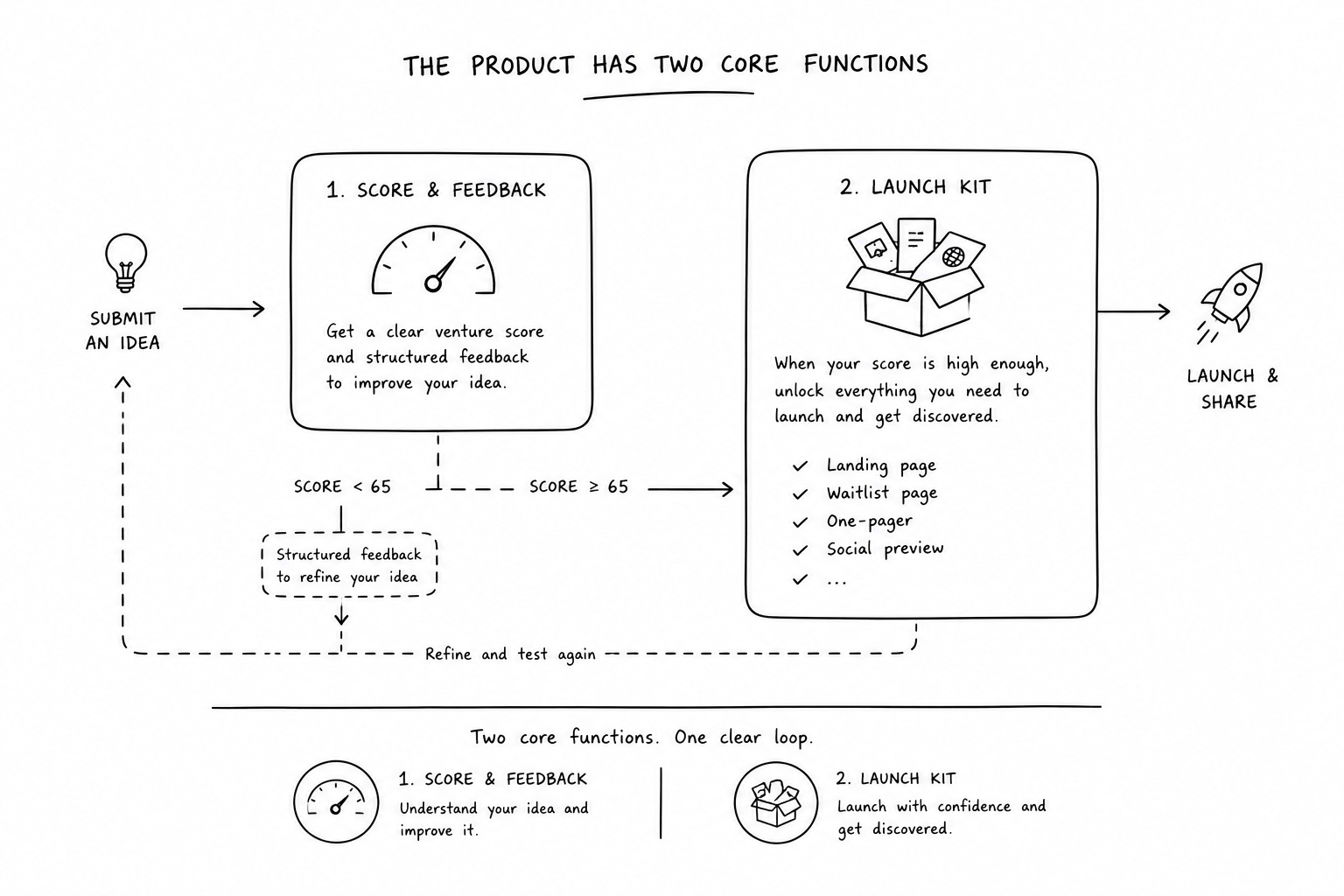
The product is built around a simple idea. A user submits an idea, and the system produces a structured evaluation along with a numerical score. If the score exceeds a certain threshold—such as 65—the system can generate a set of materials that establish the project’s minimal external presence. If the score falls below that threshold, the user receives structured feedback that can be used to refine the idea and test it again.
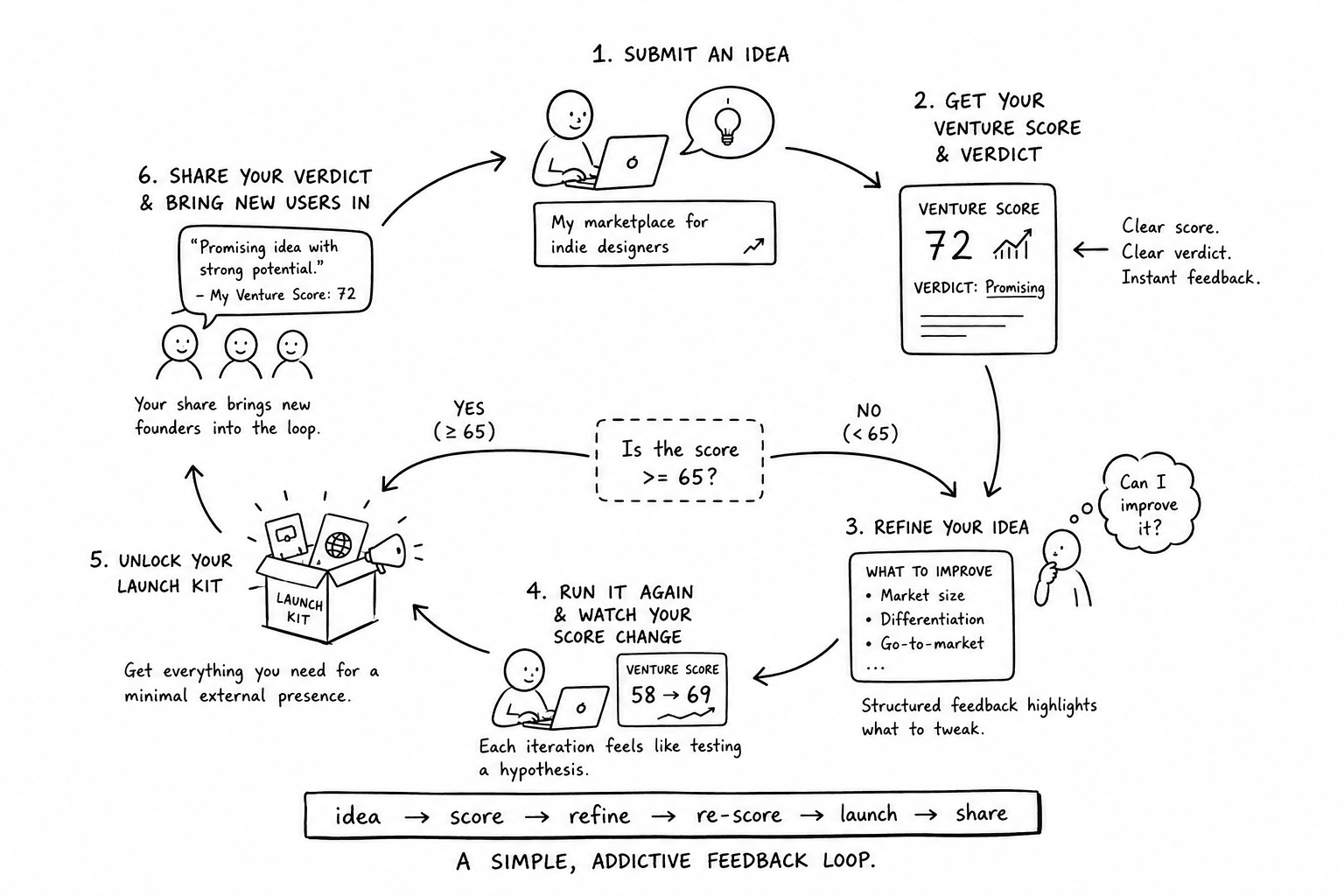
This structure creates a natural feedback loop for users. After submitting an idea, they receive a clear Venture Score and verdict, which immediately triggers curiosity: “Can I improve it?” Users then tweak the idea, run the evaluation again, and watch their score change. Each iteration feels like testing a hypothesis, turning startup thinking into a quick feedback game. As users generate better ideas, they unlock a Launch Kit and share their verdicts, which brings new users into the same loop. The result is a simple but addictive cycle: idea → score → refine → re-score → launch → share.
The scoring system is designed to simulate how investors structurally evaluate startup ideas. Each idea receives a Venture Score (0–100) derived from four core dimensions: Market Potential, Differentiation Strength, Execution Feasibility, and Capital Efficiency. Instead of producing a single opaque score, the system breaks the result into these components so founders can see why an idea performs well or poorly. Alongside the score, the model highlights patterns commonly associated with historical startup failures and provides concrete suggestions for improvement. The goal is not to “predict success,” but to turn an abstract idea into a structured evaluation—allowing founders to iterate, refine, and retest their ideas before committing real time and capital.
After the idea passes the Venture Trial and receives a score, the system generates a Launch Kit designed to create the project’s minimum external presence. Instead of producing heavy materials like full pitch decks or business plans, the Launch Kit focuses on the essentials needed to present an idea as a real project: a one-line positioning statement, a concise project description, structured landing page copy, domain name suggestions, and ready-to-use social media launch text. The goal is to compress the early stage of startup formation—turning a raw idea into something judgeable, presentable, and shareable within minutes, so founders can test narratives, communicate the concept, and begin validating it in the real world.
Conclusion
In the past, starting a company required large teams, capital, and long preparation cycles.
Today, AI is compressing all of that.
Soon, the hardest part of building companies will not be execution.
It will be deciding what is worth building.
In that world, ideas themselves become the most valuable starting point.
The goal of this project is simple: Help ideas move from imagination to venture in minutes — not months.
If the age of the one-person startup is coming, then the next generation of tools should help founders think faster, test faster, and launch faster.
Because in the AI era, the distance between an idea and reality is shrinking every day — and the builders who learn to navigate that gap fastest will define the next wave of startups.